A Little Light, With a Life of Its Own
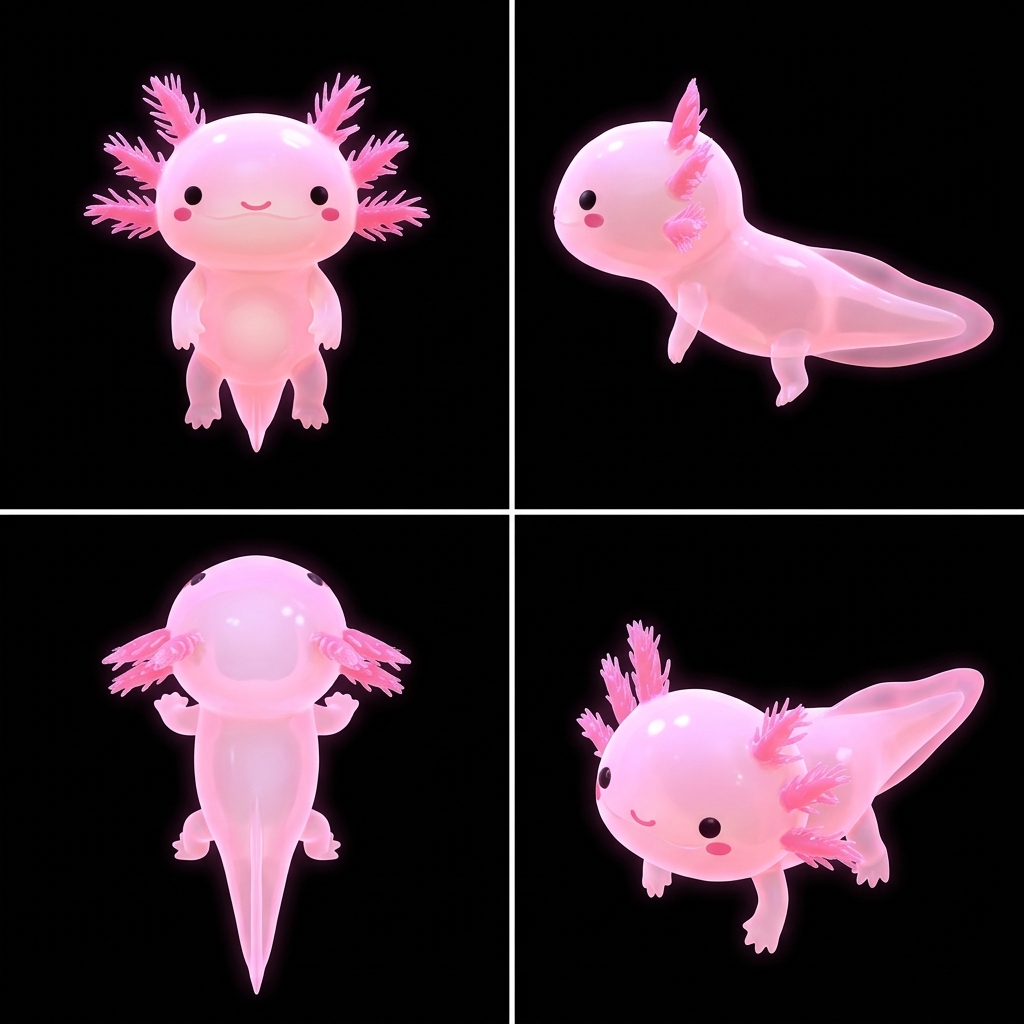
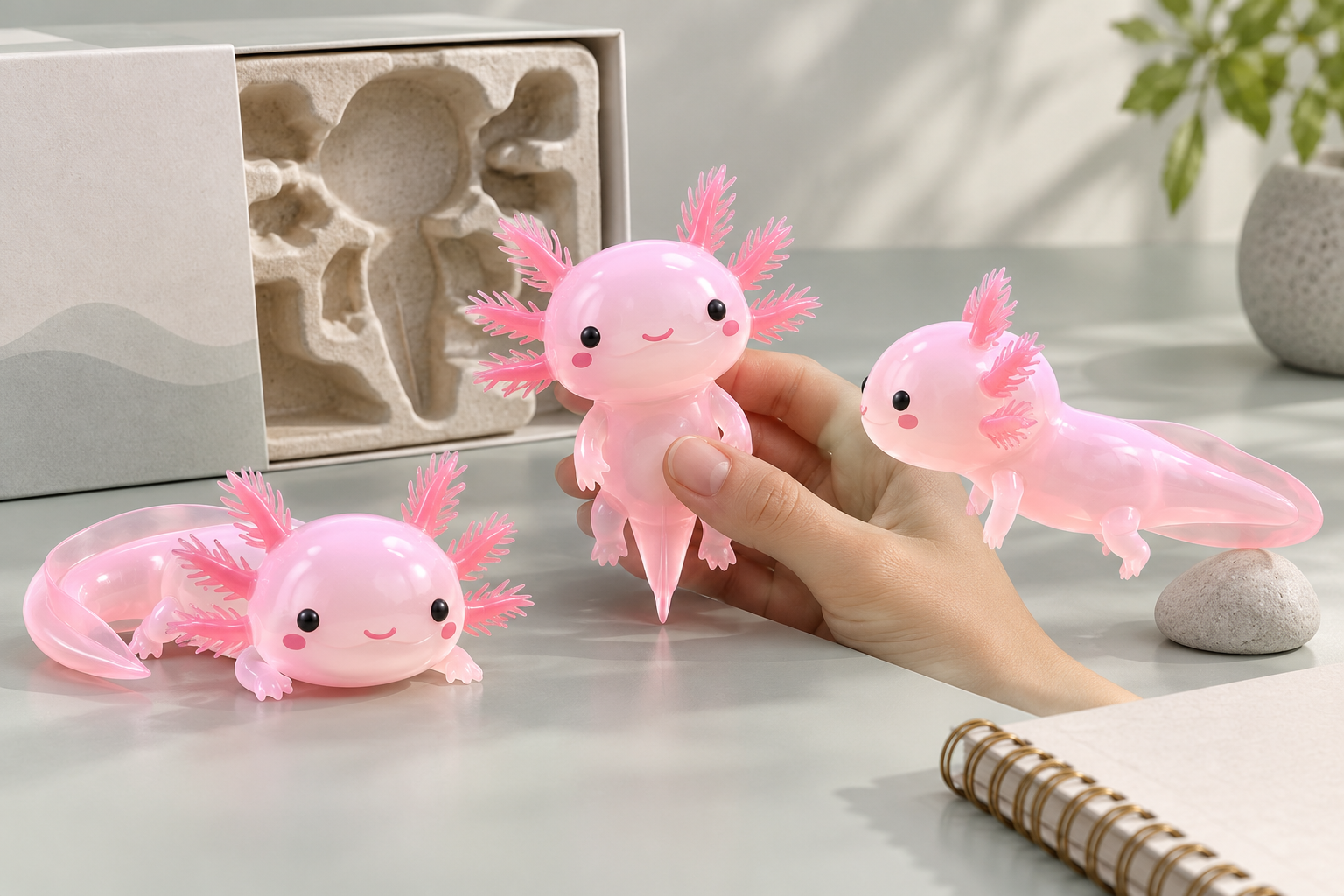
The original four-view character sheet above is the source of this independent Studio Extension. Three product roles turn the same creature into different kinds of company: a glowing desk companion, a pocket lagoon and a small non-electronic collectible. One identity, three relationships; not three unrelated objects wearing the same face.
Positioning: company without another obligation
The first audience is design-conscious adult collectors and people who enjoy low-pressure digital pets. A desk, a bedside shelf and a short train journey are the primary contexts. The promise is a small ritual of attention, not a wellbeing treatment or a replacement for a real animal. A future family edition would need its own age grading and safety work. No product is currently offered for sale.
Six gills, one unmistakable silhouette
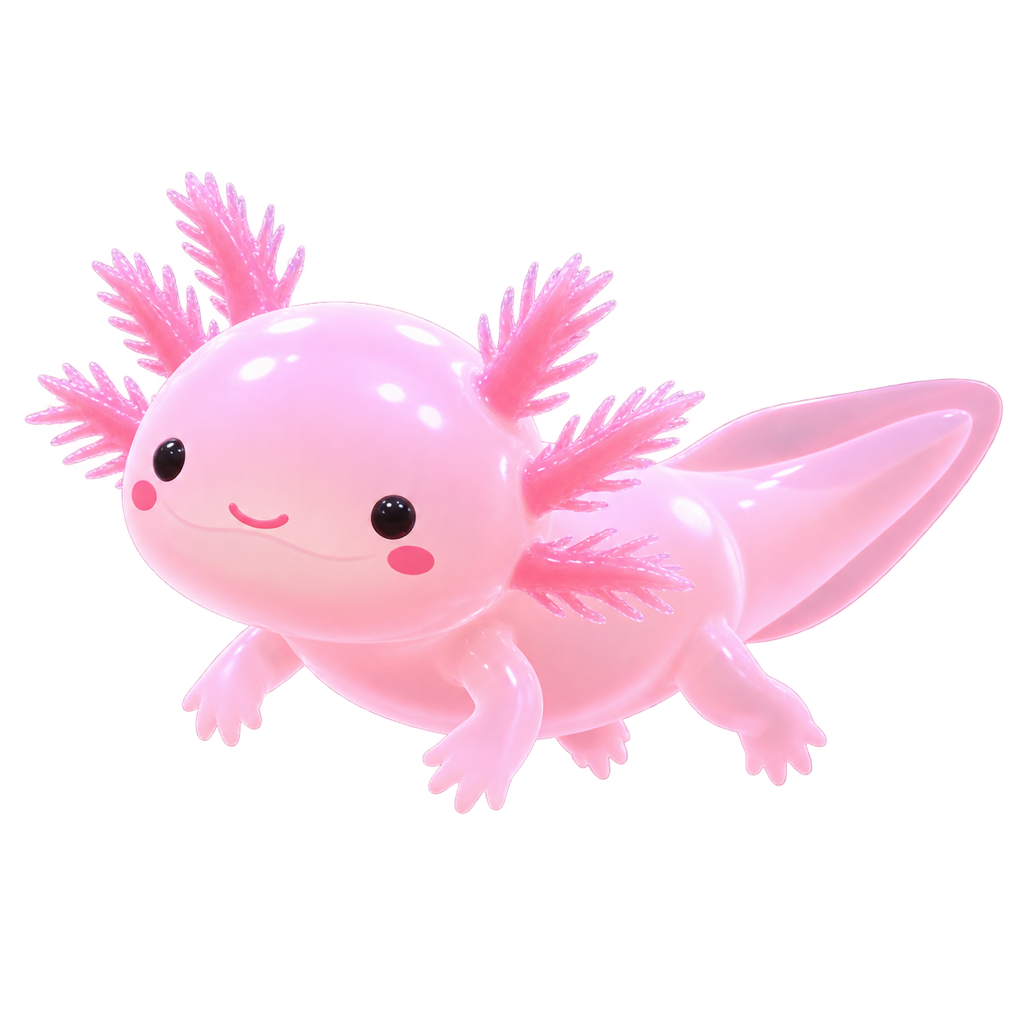
Recognition comes from a broad round head, three branching external gills on each side, black bead eyes, a tiny pink smile, rosy cheeks, four short limbs and a long tapered fin tail. The body stays translucent rose pink with a soft internal glow. Pose, light rhythm and setting can change; gill count, facial spacing and the head-to-body relationship cannot. Surface detail remains quiet so light, rather than decoration, does the expressive work.
Three routes before one commitment
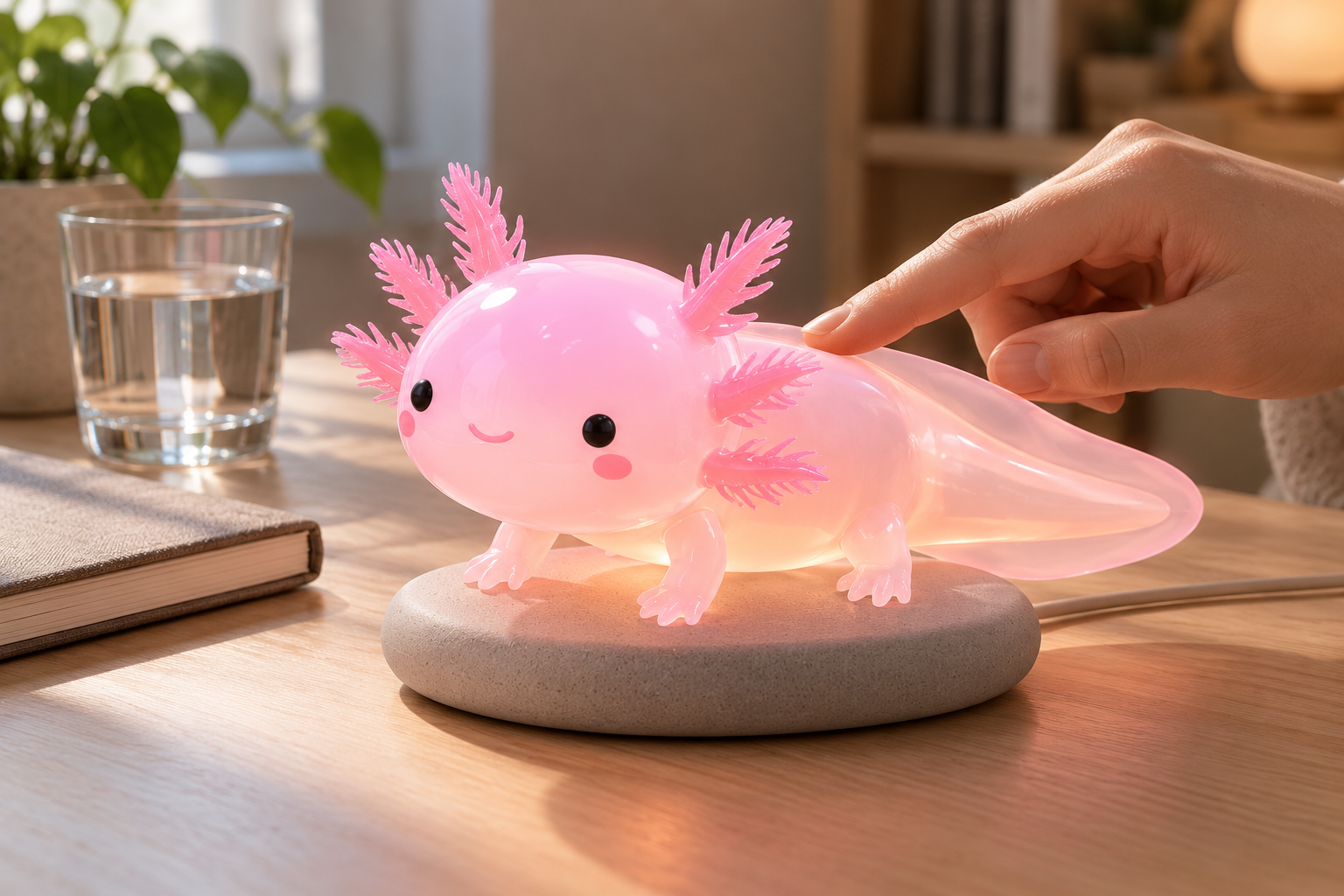
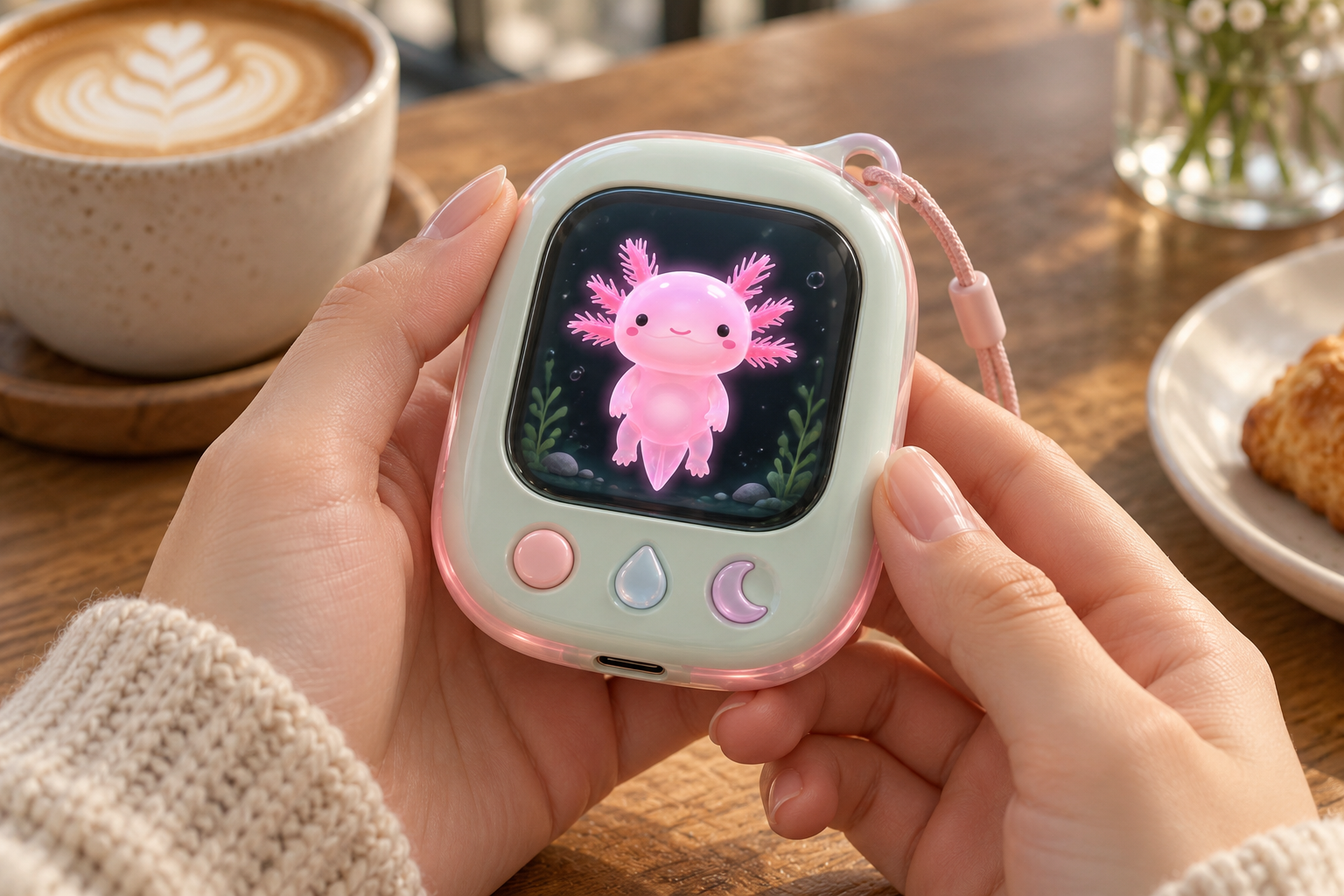
Route A is a 125 mm-high Glow Companion: expressive light, a back touch zone and a low charging dock. Route B is Pocket Lagoon: an approximately 65 x 78 x 24 mm handheld with a screen, three tactile controls and local play. Route C is a 75 mm Pond Pal: a non-electronic collectible in resting, swimming or curious poses. A has the clearest connection to the original translucent character and is the first prototype candidate. B offers deeper play but adds interface, battery and firmware complexity. C is the simplest form-and-colour study, but cannot carry the whole electronic-pet idea alone.
From glowing ornament to serviceable companion
For Route A, the proposed architecture separates a translucent outer shell, an internal light diffuser, a removable electronics cartridge and flexible gill inserts. A concealed underside service cover is preferable to a permanently sealed object. The charging contact and alignment feature belong to the broad, low dock; the tail should not become a load-bearing connector. These are design requirements, not a validated assembly or a claim that the illustrated render contains functioning electronics.
Motion without six fragile mechanisms
The first release uses light and touch, not powered limbs. This protects the delicate gill silhouette, reduces pinch points and keeps the centre of mass low. The non-electronic Pond Pal can use a fixed pose with a wide contact footprint. Any later articulated edition should place restrained pivots at the limb roots and test the tail clearance; a transparent body should not reveal a cluttered skeleton. Digital skeletal animation and physical toy joints remain separate engineering tasks.
A material palette you can explain by touch
The main shell is proposed in translucent PC or a suitably tested translucent resin for appearance samples. A soft silicone or TPE gill insert would replace brittle branching tips; its final thickness must be determined with tear and handling tests. An opal diffuser masks LED hotspots, while a matte mineral-green dock gives the luminous pink a grounded contrast. A pearl-milk and a mist-blue colour study may follow, but the rose-pink edition remains the identity reference. Battery chemistry, electrical design and material suitability require specialist validation.
The same three gestures, on every object
Snack is a small warm pulse, Explore is a ripple travelling from head towards tail, and Rest is a slow, low-intensity breath. Pocket Lagoon maps these to circle, droplet and crescent controls. The browser concept below carries the same care-and-discovery loop. A physical-to-digital connection is a future option, not an implemented feature: the first hardware brief favours offline operation and no compulsory account.
Packaging is the first habitat
A reusable paperboard habitat tray should support the body and tail without pressing on the gills. The reveal begins with the face, then the complete silhouette; a small field card introduces the three gestures. Avoid loose decorative magnets, unnecessary plastic windows and packaging that requires pulling on an appendage. The design story belongs on the card, not printed across the creature.
The next gate is a physical test, not a prettier claim
Verify the silhouette against the original from front, side, back and three-quarter views. Test tip strength, tail bending, grip comfort, dock stability, light diffusion, touch reliability, service access, surface cleaning and heat under normal and fault conditions. Determine dimensions from ergonomic and component studies, then review applicable product and battery requirements with qualified specialists. The visuals are concept renders; no CAD, print-ready model, functioning hardware or certified toy is supplied in this release.
Tiny Tides: Curiosity at a Comfortable Speed
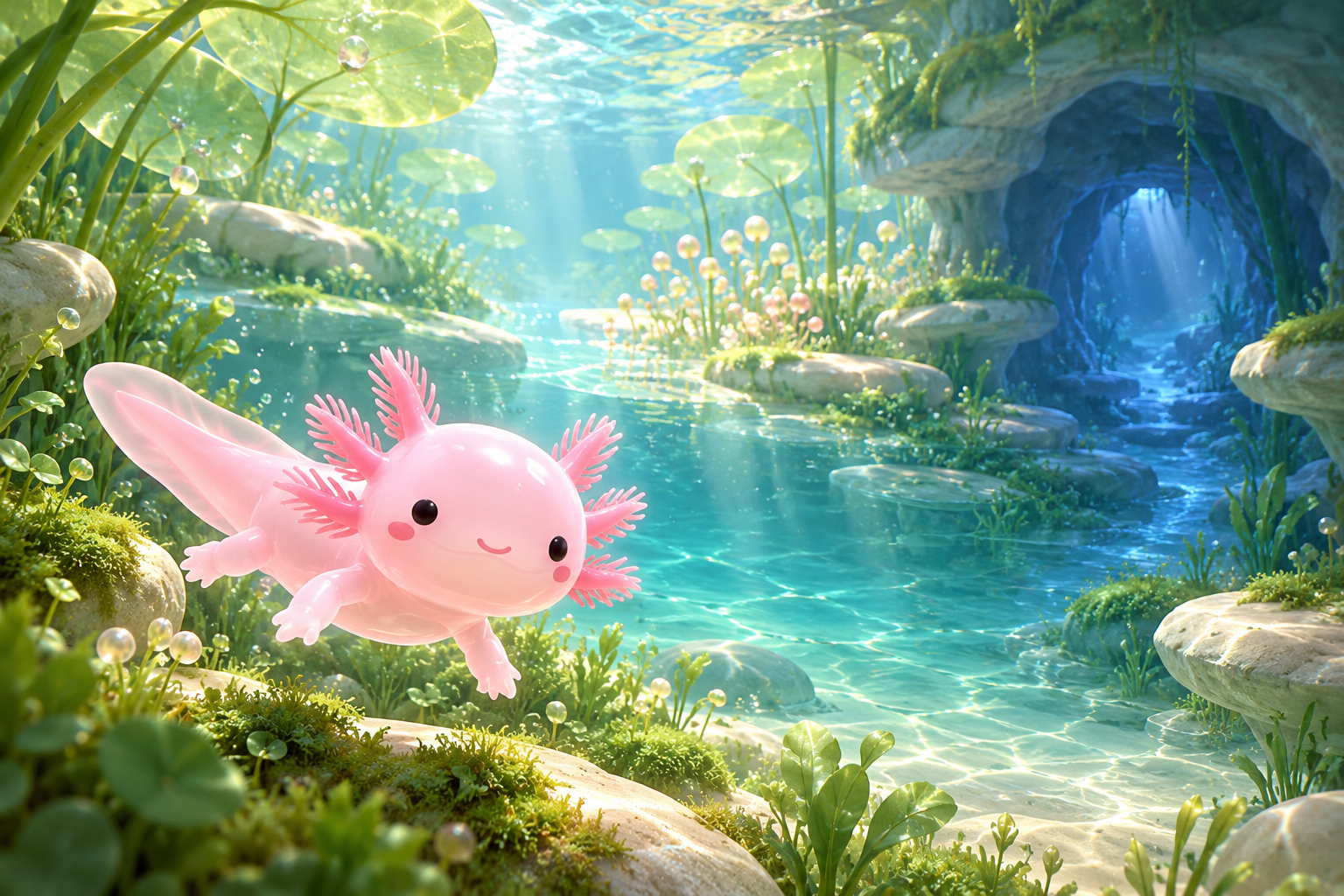
The game world grows from the animal, not from a generic pet dashboard. A small freshwater lagoon becomes a landscape of soft light, branching plants and slow discoveries. Care gives AXOS the energy to explore; exploration brings home tiny finds; those finds become a reason to look again. The playable browser concept below tests that core loop without turning affection into a deadline.
A world built from the character's anatomy
The gills suggest branching plants and sensitive currents; the translucent body suggests filtered light; the long fin tail makes drifting a natural movement language. Home Cove is sheltered and mossy, Seed Garden is open and pink-tipped, and Sound Cave gathers cool reflections and quiet echoes. The three regions share rounded stones, shallow water and a restrained palette, rather than changing visual genre at each level.
A small loop with room to grow
Snack raises comfort and energy. Explore spends 18 energy, raises curiosity and brings back an uncollected find from the current region. Rest restores energy without a timer or payment. Three completed journeys open Seed Garden; six open Sound Cave. Each region holds three discoveries. The prototype uses a deterministic discovery order so it is easy to inspect, not a paid random reward system. Longer-term play can connect seeds to habitat changes and sound fragments to a gentle lagoon composition.
Absence is not a failure state
AXOS does not die, lose affection or send guilt-inducing alerts when the player leaves. There are no streaks, energy purchases, paid blind boxes or compulsory daily quests. Progress stays in this browser; no account or personal profile is required. The prototype has optional synthesised sound and respects reduced-motion preferences. A commercial game would still need dedicated accessibility, privacy and platform review.
Personality is a timing decision
Idle behaviour should be asymmetrical and unhurried: a brief head tilt, a forelimb hover, a delayed tail follow-through. Curiosity moves forward before the body commits; rest lowers the gill motion rather than replacing the face. The current prototype includes small care-response motions and optional tones. A production animation set would add consistent swim, settle, turn, snack, surprise and sleep cycles from an approved model or carefully aligned sprite frames.
A prototype, with honest edges
This release implements care values, energy checks, three unlockable regions, nine persistent finds, milestones, reset confirmation and browser-local saving. It is not a finished commercial game, a connected hardware demo or a 3D character simulation. The environment is an illustrative concept image; the interface tracks region selection rather than pretending that three separate game levels have been built. A twelve-angle turntable should wait for one inspected model and twelve genuine views, not twelve inconsistent image generations.
What I want to learn next
Can a first-time player understand the three actions without instruction? Does a two-minute visit feel complete? Is a new find satisfying without a score explosion? Test on a small phone and with keyboard-only input, observe missed controls, check persistence in restricted browsers, and compare the screen character with the source sheet. The next design milestone is a short swim-and-rest animation plus a seed that visibly changes the habitat.
Tiny Tides
A small tide. A very large afternoon.
Little milestones
- First little journey
- Open the Seed Garden
- Listen in Sound Cave
- Nine small wonders
Pocket collection 0/9
The best souvenirs are usually small.
A Garden You Can Rearrange
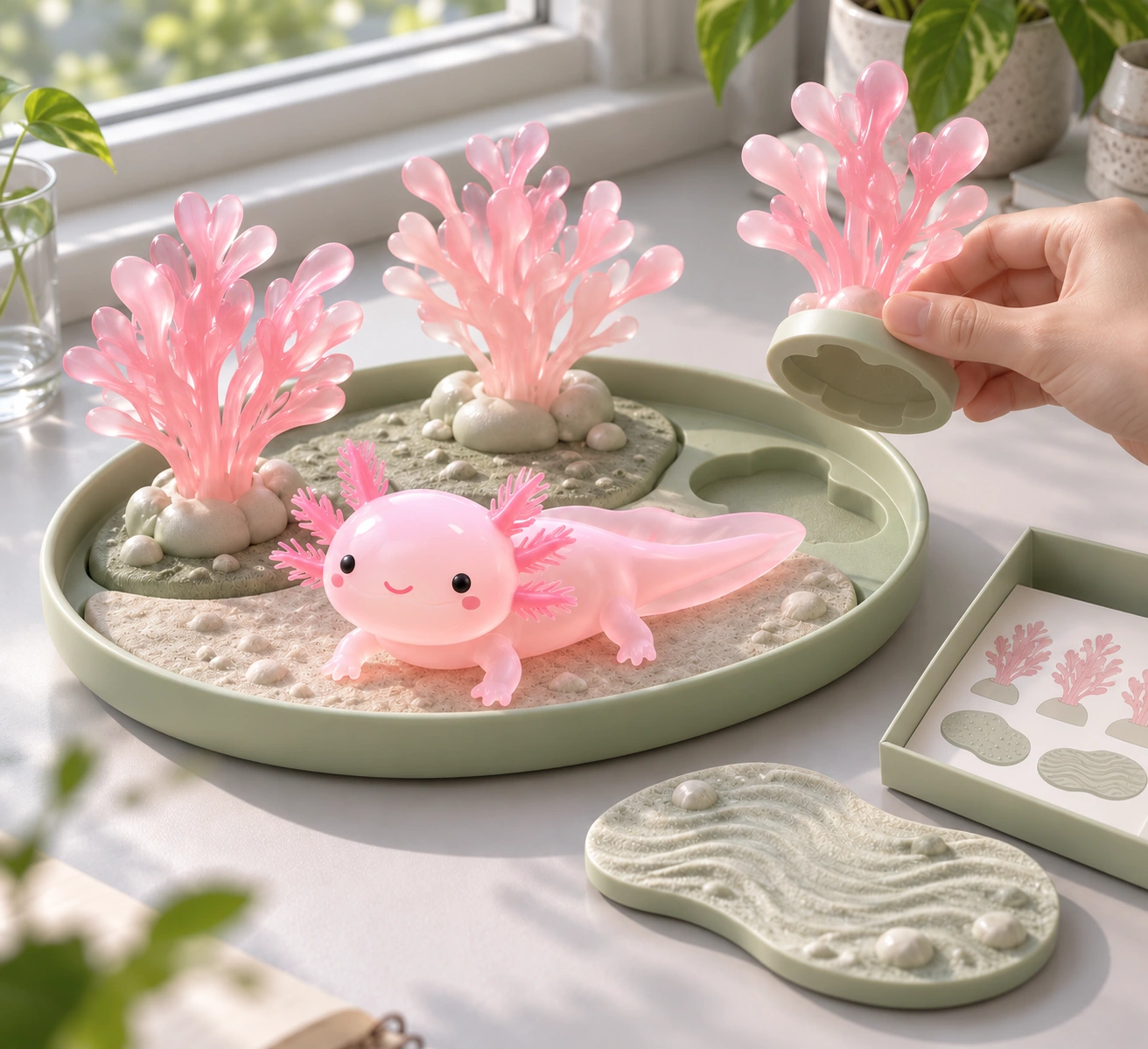
A small habitat, with no gardening guilt. This independent Studio Extension develops Seed Garden into a tactile desktop play system: lift a plant by its broad base, move a terrain tile, and make another place for AXOS to linger. The character stays itself; the landscape does the changing. The scene is an unbuilt product proposal, not evidence of manufactured hardware.
Keep the creature; change the relationship
The original four-view sheet remains the identity reference: a large rounded head, three branching gills on each side, black bead eyes, a single curved pink smile, rosy cheeks, four short limbs and a long translucent fin tail. Earlier concepts explored a glowing companion and handheld play. Here the new relationship is spatial: the owner becomes a quiet habitat-maker, rather than a caretaker answering another notification.
One tray, three kinds of change
The system separates a shallow mineral-green tray, removable terrain tiles and broad-based translucent plants. Tiles alter the ground texture; plant modules alter the skyline; the unattached character changes position. Generous keyed seats suggest placement without tiny pegs, magnets or loose seed pellets. The key establishes orientation, not a snap-lock claim. A roughly 260 by 190 mm tray and 110 mm-long character are initial scale targets for an adult collector's desk, to be revised through physical mock-ups.
The hand is part of the design
The scene shows a module being lifted by its base, not tugged by a delicate branch. Place the terrain first, seat the plants, then settle AXOS in the open foreground. Keep the tail on a continuous supported surface and leave clearance around all six gills. The tray can be rearranged between a sheltered cove and an open clearing; no score is needed to know that something changed. The design invites a two-minute pause, not a new household chore.
Material follows the kind of touch
A matte rigid tray gives the luminous rose-pink character a visual anchor. Satin terrain surfaces contrast with smooth translucent plants. Flexible plant branches and gill inserts are a prototype direction, while the broad bases need enough stiffness to locate reliably. The pebbled details should be moulded into each terrain tile, not supplied as loose pieces. Material grades, wall sections, cleaning resistance and light transmission remain open engineering decisions; this render is not a manufacturing specification.
A bridge to Tiny Tides, not a pretend connection
The plant silhouettes borrow the branching rhythm of AXOS's gills, while the rippled tile translates its fin-tail movement into ground texture. These rules give the physical and digital Seed Garden a shared vocabulary. A later game experiment could let a discovered seed visibly change the lagoon, but this release does not add hardware pairing, scan recognition or a new game mechanic. The existing browser game remains a separate playable concept.
Test the fit before celebrating the finish
Make a full-size card or foam layout first. Check reach, storage, tip resistance, tail support and whether a hand can remove every tile without bending a plant. Prototype the keyed seat with several clearances; test it after repeated insertion and cleaning. Inspect branch and gill tear strength, trapped-dirt areas and small-part risks before deciding any age grade. The illustrated underside and socket explain a placement idea only: no verified CAD, tooling, production tolerance or certified toy is supplied. A garden should be forgiving. Its joints should be less philosophical.