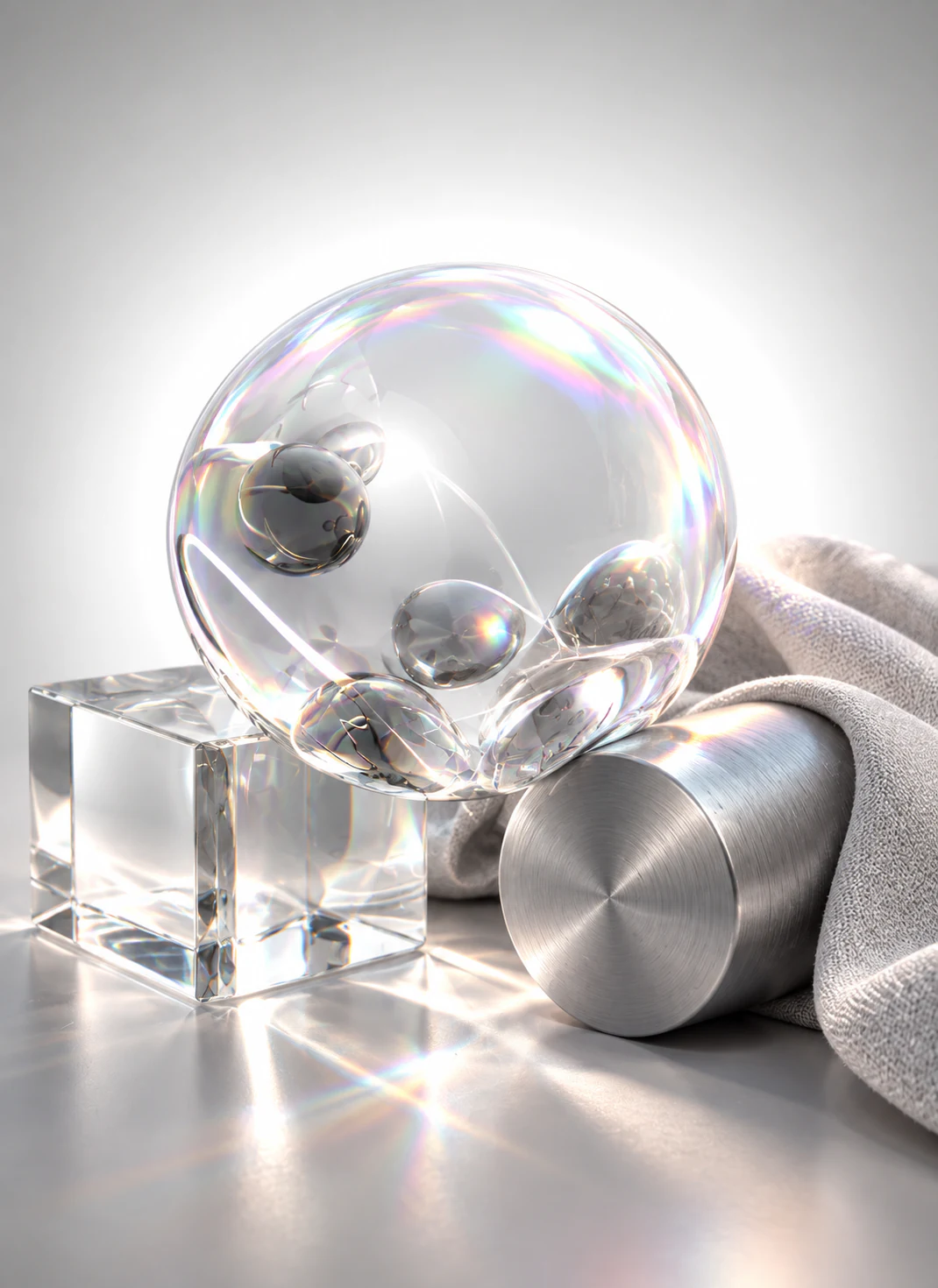
Surface Tension
The bubble study becomes a compact material laboratory in this independent extension. Translucency, refraction, softness and scale are tested as a family rather than as isolated effects. The result treats 3D rendering as design judgement: realism matters, but character begins where perfect physics is gently persuaded to misbehave.
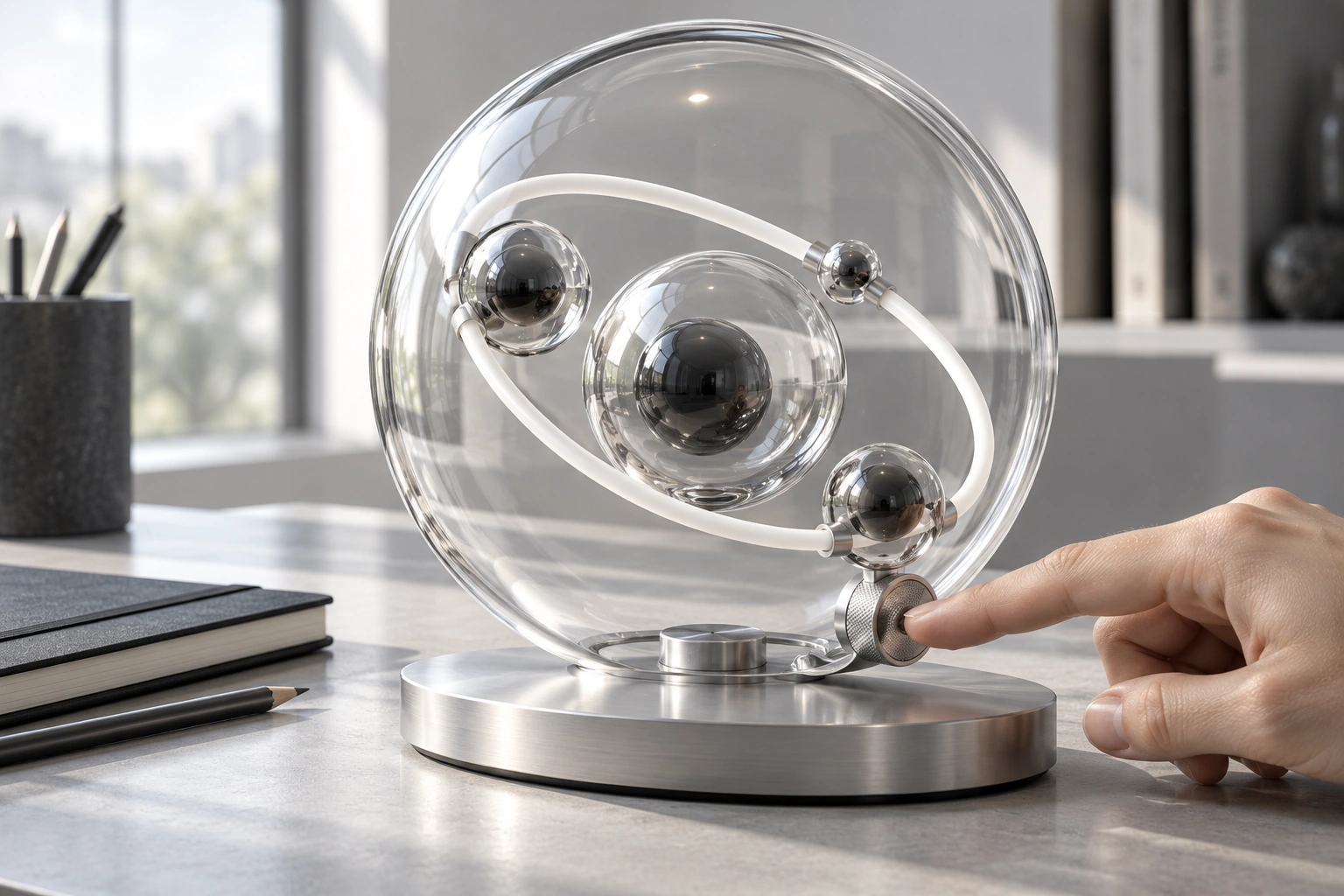
Held in Orbit
The 2014 bubble composition becomes a small system you can set in motion. A fixed central lens, a single rotating orbital carrier and three unequal captive spheres translate the original's suspended cluster into an adult collector's desk object. The earlier material study asked what a bubble might feel like. This independent Studio Extension asks how its relationships can change without coming apart. The scene is an unbuilt product proposal; the motion study tests a visual rule, not a proven mechanism.
Recognition lives between the objects
The source is a monochrome field of transparent spheres, dark reflective cores and fine white ribbons. Varied scale and asymmetry keep it from becoming a diagram of an atom. Those are the anchors here: clear outer volume, smoky inner mass, a pale continuous orbit and unequal satellites. The new setting gives them weight and a hand-sized relationship. Colour is deliberately withheld; changing everything is a very efficient way to lose the idea.
A desk toy with a compositional job
The intended audience is adult design collectors, with a desk or reading shelf as the first setting. A roughly 230 mm-wide base and 170 mm enclosure are starting scale targets for mock-ups, not dimensions recoverable from the image. The owner turns one lower wheel and watches three unevenly spaced satellites change their relationship to the fixed centre. There is no score, battery or promise of therapeutic benefit. It is a miniature exercise in seeing, with a place to put your finger.
Three routes, one useful constraint
Loose transparent marbles would retain the source's lightness but introduce storage and small-part problems. An exposed multi-axis armillary would offer movement but add hoops that overwhelm the original's slender ribbons. The chosen route uses one orbital carrier with retained spheres and a broad base. Satellite spacing remains fixed on the carrier; the whole group rotates. A clear front guard is the intended boundary between the moving composition and the hand. The image communicates that enclosure direction, not verified guarding or clearance.
Separate the optical object from the mechanism
The fixed central lens sits on a rear support. An annular carrier rotates in a separate plane, with the three spheres held by collars rather than friction alone. A lower thumb wheel is intended to drive the carrier through a concealed friction or geared transmission, to be selected after torque and wear tests. A removable rear cover would expose bearings and retention features for service. The render does not resolve that hidden transmission, fasteners or collision envelope. The diagram below simplifies the assembly further and is not a section drawing or CAD model.
Transparency needs fewer secrets
A clear impact-resistant polymer is the first appearance-prototype direction for the guard and sphere shells; polished clear resin can test appearance but is not assumed suitable for final use. A satin white carrier preserves the source's ribbon, while smoky inserts create depth without loose liquid or metal pellets. The low aluminium-look base supplies visual weight; actual ballast and non-slip feet require a tipping study. Scratches, dust, seam placement and cleaning access are design problems, not retouching tasks. Material grades and manufacturing processes remain undecided.
The motion rule is shared, not simulated physics
In the browser study, all three spheres advance by the same angle while retaining their relative spacing and size. The centre stays still. A twelve-second loop makes that single degree of freedom legible; it is not a 360-degree camera render, optical simulation or claim of free spinning. Playback starts paused, manual adjustment stops it, and page hiding or a change in reduced-motion preference pauses it. The simplified projection tests rhythm and balance before anyone invests in tooling.
Prototype the resistance before the reflection
Begin with a full-size opaque card assembly and a simple retained carrier. Check finger reach, turning force, slipping, sphere retention, support clearance and tipping in every orientation. Then test the guard, wheel recess, pinch access, impact, wear, cleaning and surface scratching. Inspect the full movement envelope before adding polished optical parts. Any age grading and market-specific product requirements need qualified review; this is not a certified children's toy, print-ready file or manufacturing release. A bubble may look weightless. The design still has to stay on the desk.